Short answers created from the syllabus dotpoints.
Explain the changing patterns of religious adherence between 1945 and 2001 using census data.
The consistent increase in migration has lead to a change in the patterns of religious adherence from 1945. Australia, for the most part, is known as a Christian dominated country. Immigration, however, has allowed the nation to develop from an Anglo-Celtic, Catholic domination into a multicultural multifaith society.
The religions in the Australian Census Data, 1947-2001 from the Australian Bureau of Statistics demonstrates the changing patterns of religious adherence since 1947. The data reveals a decrease in the number of adherences of the three largest Christian denominations of Catholics, Anglicans and Uniting Church. The statistics decreased from a dominating 81.2% in 1947 to 56.9% in 2001. The census data also reveals a rapid increase in percentage under ‘no religion’, from 0.3% in 1947 to 15.5% in 2001. The option of ‘if no religion, write none’ was introduced in 1971, enhancing such an increase. Individuals identifying themselves as ‘spiritually’ would consider themselves religious but would not be able to define what religious category they belong to, thus identifying themselves best with ‘no religion’. Such increase in ‘no religion’ is also due to the fact that in today’s society it is more acceptable to consider yourself atheist or as not having a religion.
Simultaneously as the population of Australia increases, there is an evident increase in foreign religions. Hinduism, Islam and Buddhism, show a significant increase, especially after 1981. The data reveals that between 1981 and 2001 Buddhism increased from 0.2% to 1.9%, Islam increased from 0.5% to 1.5%, and Hinduism reached 0.5% by 2001.
The information presented on the census may be deemed unreliable. The question on religion in the census is not compulsory and many adherences prefer stating ‘no religion’. However, if one were to rely on the statistics exposed in the census, it is evident that Christianity was the only religion with negative growth. As the nation rapidly increases in population and multiculturalism, it is logical to state that religions will diversify with foreign religions increasing in adherents due to the increase in immigration.
‘At census time most people make some sort of religious profession by describing themselves on the form as Anglican, or Catholic, or Methodist or some other denominational adherent. I wonder what it really means. There are many...Australians, [probably some who call themselves Christians on the census return, who relay have no religious profession or religious practise.’
Paul Hasluck (1992), ‘Then and now-religion’, In Quadrant, col. 30, no. 11, p. 47. (Sir Paul Hasluck d, 1993 was Governor-Gneral of Australia 1969-1974) Cited in the Living Religion textbook, Third Edition (2007) page 259.
-Gabriela Sanchez
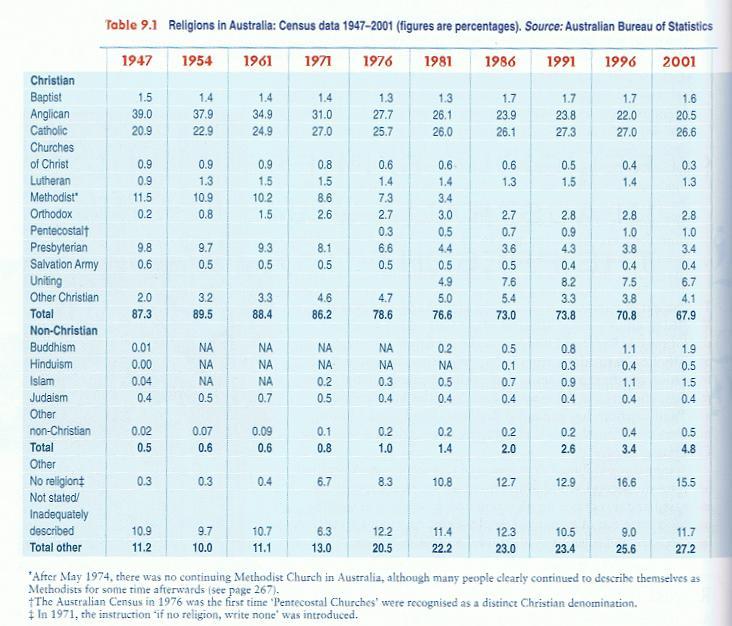
Religions in Australia: Census Data 1947-2001 from the Australian Bureau of Statistics. Above response written according to these statistics.
Outline the significance of secularisation and the rise of New Age religions, to the present religious landscape in Australia.
A significant factor that has contributed to the religious landscape of contemporary Australia is the increase of people separating themselves from religious influence. There has been an increasing propensity of people, in Census data, identifying themselves as possessing ‘no religion’. Between 1947 and 2001, there was a 16.3% increase in people who had identified that they had no religion. More evidence to support the fact that Australia is becoming further secularised are the results attained by the Australian National University, where a question was proposed as to the significance of religion. From the respondents, 42% had identified that religion was not important to them and consequently does not play a large role in their life.
It is important to observe the fact that whilst people have identified themselves as possessing a religion, the impact and significance of that religion to the individual’s life is insignificant. Since 1788, regular church attendance in Australia has often wavered between 10-20%. A survey conducted by the National Church Life, in 2001, found that 18.6% of respondents attended Church regularly, which meant at least once a month. Also found was that 76% of respondents, who said that they attended Church regularly were over the age of 40. This allows for the conclusion that of the 70% of Australians who claim that they are Christian, 1 in 5 attends Church at least once a month. And of those 1 in 5, 4 in 5 are over the age of 40.
As secularisation becomes more of a predominant factor of the contemporary Australian religious landscape, people have moved away from traditional forms of religious expression and some have adopted New Age religions. New Age religions have been a phenomenon in Australia since the 1970’s, characterised by ‘an interest in the body and experience, objects and rituals, both traditional, and to a greater extent, invented’ (Living Religion, Third Edition, 2006). Whilst New Age religions are not categorised or identified in census data, they present a challenge to traditional religions. That is, those who identify with traditional religions subconsciously integrate concepts of New Age religions within their everyday lives.
-Daniel Taha
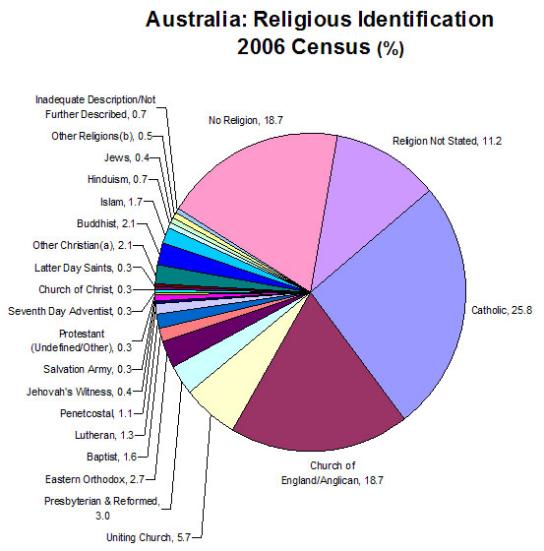
Graph demonstrating the religious distribution amongst Australia in 2006.
Source found on the Australian Human Rights Commission website.
Last update: February 8, 2010
