Answers found at the end of the page. Use Glossary of Terms to fill in the blanks.
Immigration and the Australian Religious Landscape
Post 1945, _______¹ has been a significant factor in determining the religious landscape of contemporary Australian society. The end of World War II saw an increase in the immigration of European’s to Australia, which meant that Christianity was _________² as various __________³ of Christianity became more apparent. Australia had emerged out of its narrow __________⁴ hegemony.
During the 1950’s, there were significant waves of immigration to Australia from Hungary and South Africa, as well as Russia and Israel in the 1970’s and 1980’s. These immigration waves continued to diversify Christianity within Australia, as further denominations of this religion were introduced. Also, Judaism became an apparent religion within society, with both South Africa and Israel contributing significantly to the increase of _________⁵ people within Australia.
During the 1990’s, immigration from countries of the Middle East and Asia saw an increase in the ____________⁶ of Islam, Buddhism and Hinduism. ____________⁷ data from 1947-2001, attained from the Australian Bureau of Statistics presents that post 1991, Islam, Buddhism and Hinduism have had significant percentile growth within Australia. Islam has had a 1-percentile growth of adherents, Buddhism has had a 1.4 percentile growth and Hinduism has had a 0.5 percentile growth. These growths are juxtaposed against the decrease of adherents identifying with Christianity and Judaism. Post 1991, Christianity has endured a 6-percentile loss in adherents, and Judaism has endured a 0.1 percentile loss in adherents. It is important to also note that those who stated they had no religion increased by 3-percentile post 1991.
Ecumenism
In an increasingly __________⁸ society, where many seem to be separating themselves from any religious influence, Australian mainstream churches have emphasised the need for unity amongst the various denominations of _________⁹. This effort, commonly referred to as __________¹⁰, is defined as the organised attempt to bring about cooperation and unity between all the believers of Christ.
There exist two main approaches to ecumenism that exist within society. Firstly, there is a ______________¹¹ approach to ecumenism, which describes an event or organisation where individuals participate without reference to their own Christian ___________¹², as exemplified by the ‘Young Men’s Christian Association’. This approach seeks to overcome differences with the ultimate aim of unity. The other is an ______________¹³ approach, which describes an event or organisation where individuals participate as members of their individual denomination. This approach sees differences as a source of enrichment, and utilises it accordingly to unite the various denomination. An example of this can include __________ ¹⁴, where congregations swap ministers or priests for a service.
Interfaith Dialogue
Post World War II saw the diversification of Australia’s ethnic and religious make-up. As a result, Australia was forced to reassess old _________¹⁵ ways. By the 1990’s, it was apparent that religions other than Christianity had become perceptible within Australian society. As a result, conversation between religions became a need in multifaith Australia.
__________¹⁶ refers to the conversation and cooperation established between the people of different religious faiths that aim to develop familiarity and promote understanding and dialogue. It is important for interfaith dialogue to exist within a society such as Australia’s, as the five major religions of the world have to co-exist and operate together. Australia’s multicultural identity has contributed to the diversification of religion in Australia. In 1989, the fifth World Conference on Religion and Peace was held in Melbourne, and was considered a turning point in the religious relations of Australia.
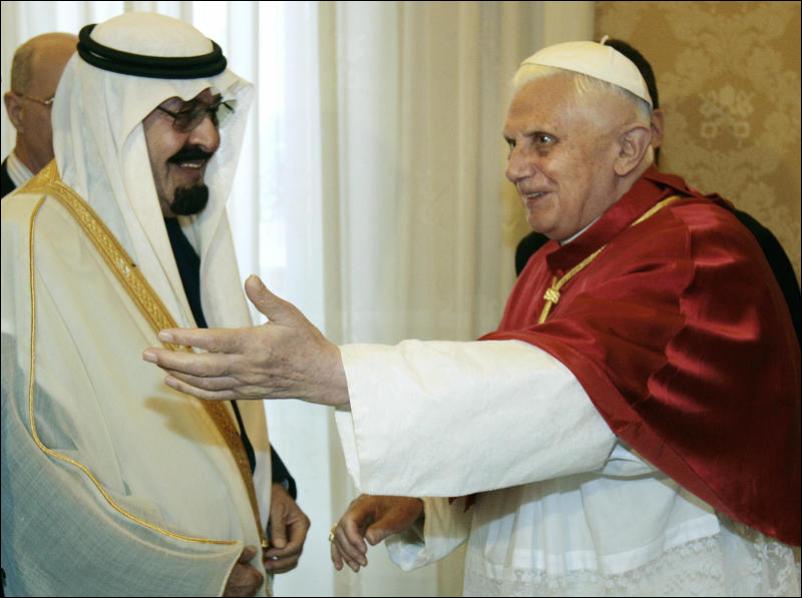
Pope and Muslim Leader promote interfaith dialogue between Islam and Christianity.
http://catchthefire.com.au/blog/wp-content/uploads/2008/11/interfaith.gif
Cloze passage answers:
¹ Immigration, ² Diversified, ³ Denominations, ⁴ Anglo Celtic, ⁵ Jewish, ⁶ Adherents, ⁷Census, ⁸ Secularised, ⁹ Christianity, ¹⁰ Ecumenism, ¹¹ Non-Denominational, ¹² Denomination, ¹³ Inter-Denominational, ¹⁴ Pulpit Exchanges, ¹⁵ Sectarian, ¹⁶ Interfaith Dialogue
Last update: February 8, 2010

